The Custozza monument - Alba iulia

The Custozza monument

 Situated in the centre of the citadel's park near the Union Hall, the piramid shaped monument stands on a stair like base and it is surrounded by chains and cannon-balls. It has been unraveled in 1906 in the memory of the officers and soldiers of the 50th Infantry Regiment from Alba Iulia who gave their lives in the Battle near Custozza in the Austro-italic war in 1866. The majority of men whose names are carved into marble, are romanians from Alba county, forced to fight in harsh conditions for a cause thad did not belogn to them.


The Greek-Orthodox Cathedral - Alba Iulia - Romania

The Greek-Orthodox Cathedral, a monumental ensemble raised in 1921-1922 in the traditional Romanian style similat to that representing the Targoviste royal church - a succesor of the old Balgrad Metropolitan church dating from Michel the Brave's time  in Alba iulia.

Also it was destined to serve de crowning ceremony of King Ferdinant and Queen Marie of Romania a cimentation of the union act from 1918.


The Cathedral was designed by the architect Victor Stefanescu, and the project carried out by the engeneer Tiberiu Eremia. It has a quadrilater shape and the church stands in the centre. The church is shaped in a greek cross and is represented by three towers and is decorated in a neo-brancovenean style. 

The entire building is dominated by the 58 m (156 ft) tall bell's tower situated on the west wing.

Since 1975 the edifice has become the Center of Alba Iulia's Orthodox Episcopy, the owner of an important colection of medieval artifacts and most important old Romanian books.

The Obelisk

This monument represents the struggle for freedom, the heroism with which the Romanian folk fought the revolution in 1784. The leaders of the revolution (represented on the west side of the monument) Horia, Closca and Crisan were captured and executed. But still, the act of great sacrifice is a milestone for the Romanian people in reaching the final national goal of a nation- independence !

" The Obelisk
In 1937, a beautiful obelisk was built in front of the Third Gate. The Project was initiated by "Astra" and carried through by local voluntary contribution. The monument is dedicated to the memory of the leaders of the great serves revolt (1784-1785). It is a monolithic monument, realized by the architect E. Mihalton and the sculptor Negrulea.It has a symbolical call at the base a winged Victory holding a laurel crown at the western side. In the pedestal of the obelisk has been carved the following homage to the three martyrs: "Homage to Horea, Closca and Crisan". " -
Historical data - by Alba iulia Online

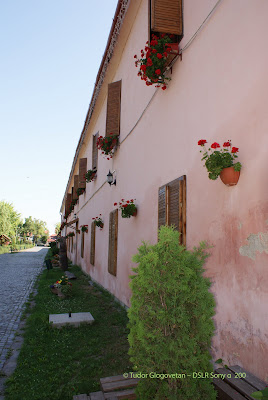
Flowers


The first official record referring to the Sibiu area comes from 1191, when Pope Celestine III confirmed the existence of the free prepositure of the German settlers in Transylvania, the prepositure having its headquarters in Sibiu, named Cibinium at that time.[2] It was probably built near a Roman settlement, one that would be known during the early Middle Ages as Caedonia.
Milestones in Sibiu's history

Numerous street signs in Sibiu are bilingual (Romanian and German)
1191 - Mentioned for the first time in a document of the Vatican, under the name "Cibinium" (due to the river Cibin that flows through the city)
1292 - The first hospital in the Kingdom of Hungary, present-day Romania was opened.
1380 - The first documented school in the Kingdom of Hungary, present-day Romania.
1494 - The first pharmacy in the Kingdom of Hungary, present-day Romania.
1534 - The first paper mill in the Kingdom of Hungary, present-day Romania.
1544 - The first book in the Romanian language was printed in Sibiu.
1551 - Conrad Haas' experiment with rockets.
1570 - Transylvania became an independent principality
1671 - Methane gas was discovered near Sibiu.
1782 - Franz-Joseph Müller von Reichenstein discovered the chemical element tellurium.[3][4]
1788 - First theatre in Transylvania, present-day Romania.
1795 - The first lightning rod in Transylvania and in Southeastern Europe was installed in Nagydisznód (present-day Cisnădie).
1797 - Samuel Hahnemann opened the world's first homeopathic laboratory.
1817 - The Brukenthal Museum, the first museum in the Transylvania, present-day Romania, was opened.
1867 - Principality of Transylvania becomes part of Hungary, from Dual Monarchy Austria-Hungary
1896 - The first use of electricity in the Austria-Hungary, present-day Romania, and the first power line in Southeastern Europe.
1904 - The second city in Europe to use an electric-powered trolley.
1918 - Union of Transylvania and Romania. Hermannstadt/Nagyszeben became part of Romania
1928 - The first zoo in Romania.
1941 - Saxons lost their historical majority in the population
1989 - The third city to take part in the Romanian Revolution.
2007 - European Capital of Culture 2007


Historic facts provided by Wikipedia


Welcome to SIBIU !


Color temperature.


An incandescend body, will create a light spectrum, and the spectrum’s color is related to the temperature at which the body is heated.

 As seen below, the colors vary for a certain body depending on the temperature point the body reaches

TEMPERATURE (Celsius)
RADIATION
250
infrared
500
red
700
yellow
900
green
1100
blue
1800
UV (ultraviolet)

The change between colors happens trough intermediate colors as the body gets hotter or colder. At a low temperature the body would create a mostly red spectrum but as the temperature increases the rpectrum would turn to blue. 

 As daylight is formed from the mixed Red Green and Blue light, (33%,33%,33%) it explains the previous phenomenon as an unbalanced mix between these essential collors.

 The color temperature is measured in Kelvin degrees, at 0 ̊ C + the real temperature of the body. For exemple for the Nitraphot lamp (2927 ̊ C)

 Tk = 2927 ̊ C + 273 = 3200 K


The color temperature varies during daytime, it’s rich in red in the morning an evening but during the day it’s mostly blue. This color fluctuation can be influenced by mereorological factors, season or geographical situation. Artificial sources are influenced by the degree of usage or the power fluctuations.

Try diferent color filters or color filter settings.